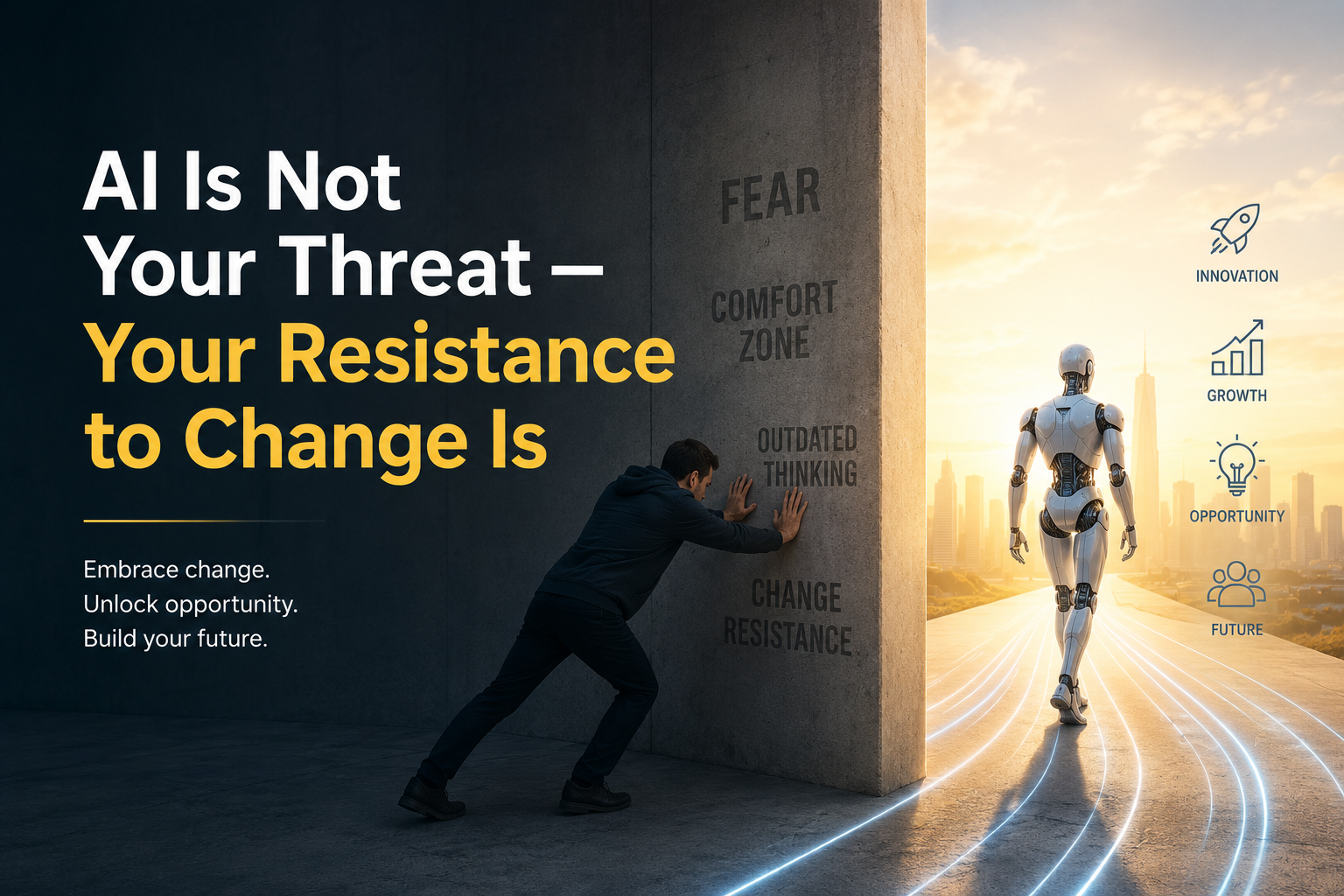
Leaders who fear AI are asking the wrong question. The real question is: what kind of leadership does an AI-accelerated world actually require?
Every week, at least one leader tells me they're worried about AI replacing their team. The fear is understandable. The headlines are dramatic. The capabilities are genuinely impressive. But in almost every case, these leaders are asking the wrong question.
The question is not: will AI replace my people? The question is: am I the kind of leader who can navigate the transformation that AI is forcing on every organization? Because the leaders who will struggle are not those whose jobs AI threatens. They are those whose rigidity AI exposes.
What AI Actually Disrupts
AI disrupts repetitive cognitive work — analysis, documentation, summarization, pattern recognition. It accelerates processes that used to take weeks into hours. It gives organizations with fewer resources the ability to punch far above their weight.
What AI does not disrupt — what it actually amplifies the need for — is human judgment, ethical reasoning, relationship building, creative synthesis, and leadership. The more AI handles the cognitive scaffolding of work, the more the uniquely human dimensions of leadership become the differentiator.
“AI is a mirror. It reflects, clearly, which leadership capabilities are actually human — and which were never really leadership at all.
— Sanjay Koul
The Three Capabilities AI-Era Leaders Need
Based on my advisory work with organizations navigating digital transformation, three leadership capabilities matter more in an AI-accelerated world than in any previous era.
Intellectual Curiosity
The willingness to continuously learn and unlearn. Leaders who treat AI as something to understand — not fear — will adapt fastest.
Human-Centered Judgment
AI surfaces options; leaders must make choices. Decisions with ethical weight, cultural implications, or relational complexity require human judgment that AI cannot replicate.
Adaptive Comfort with Ambiguity
AI is evolving faster than any training program can track. Leaders must become comfortable operating with incomplete maps — making good-enough decisions and course-correcting quickly.
The Real Threat: Fear-Driven Paralysis
The organizations I worry about are not the ones being disrupted by AI. They're the ones where senior leaders are so threatened by AI that they've quietly declared it irrelevant, resisted adoption, and created a culture where curiosity about technology is seen as disloyalty to the current way of doing things.
This is not new. Every wave of technological disruption — the internet, mobile, cloud — has been met by some leaders with fear and others with curiosity. The pattern is consistent: the curious ones thrived. The resistant ones were eventually replaced by people who weren't afraid to ask 'what if'.
A Practical Starting Point
If you're a senior leader navigating AI for the first time, I suggest starting with a simple personal experiment: spend one week using an AI tool — any tool — on a real problem in your work. Not to replace your thinking. To augment it. Notice where it adds value. Notice where it falls short. Notice what questions it raises.
That experiment will teach you more about AI leadership than any conference keynote or executive briefing. It will also give you a lived experience to bring into conversations with your team — which is exactly the kind of learning-by-doing that people-first leadership demands.
In an AI-accelerated world, the most human qualities of leadership — empathy, judgment, wisdom, trust — become the rarest and most valuable. That should be a source of confidence, not fear.
“The leaders who thrive in an AI world are not the most technical. They are the most human.
— Sanjay Koul