Corporate leadership programs spend billions annually. Yet leadership pipelines remain thin. The problem isn't effort — it's the wrong model entirely.
The global corporate training industry is worth over $370 billion annually. Leadership development sits at the top of most HR priority lists. And yet, when you ask senior leaders whether their organizations have a strong leadership pipeline, the answer is almost universally: no.
This is not a funding problem. It's not a content problem. It is a model problem. The dominant approach to leadership development is fundamentally flawed — and understanding why is the first step to fixing it.
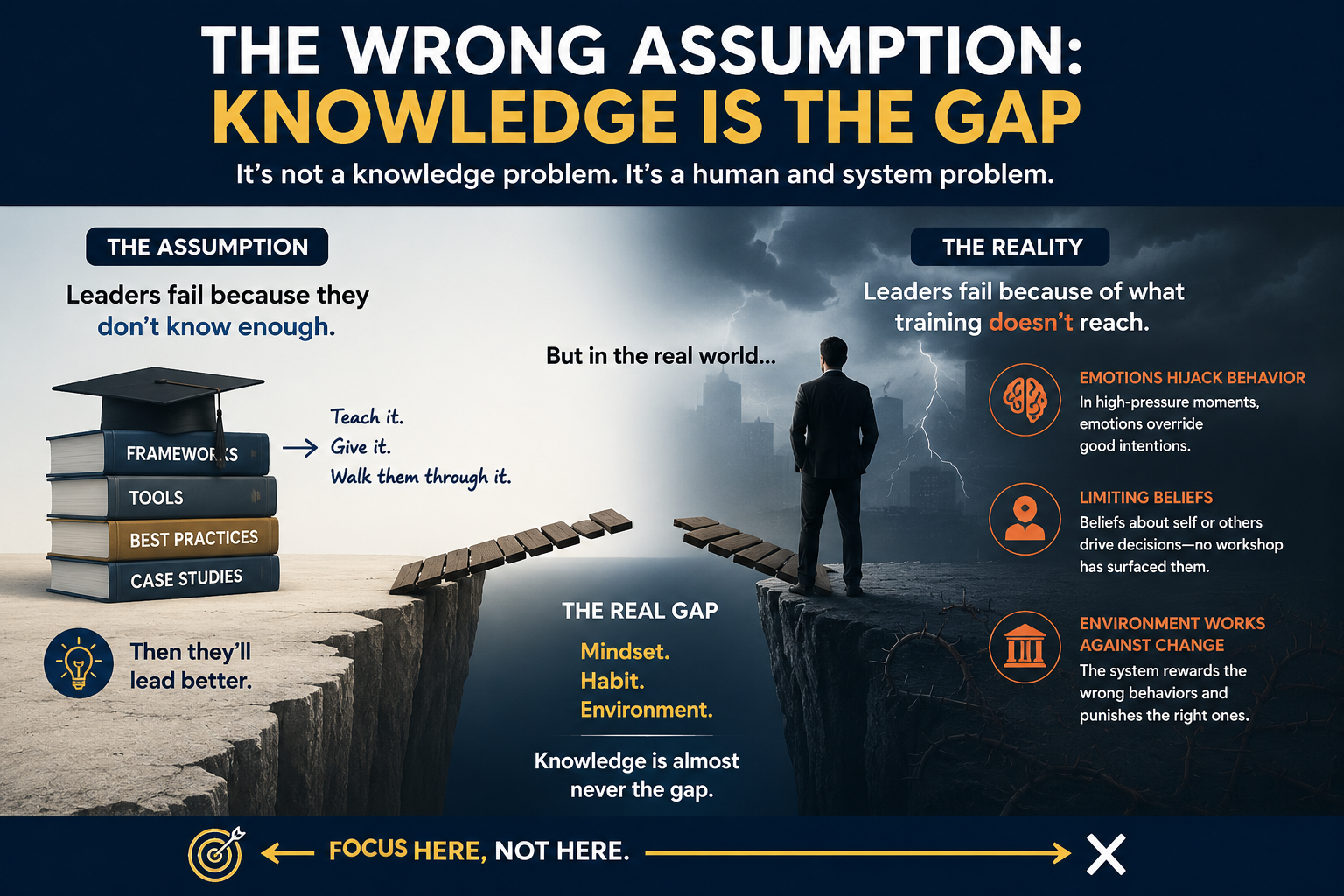
The Wrong Assumption: Knowledge Is the Gap
Most training programs are built on an implicit assumption: that leaders fail because they don't know enough. Teach them the right frameworks, give them the right tools, walk them through the right case studies — and they'll lead better.
But watch a leader in the real world. They don't fail because they've never heard of a feedback model. They fail because in a high-pressure moment, their emotions hijack their behavior. They fail because of beliefs they hold about themselves or their team — beliefs no workshop has ever surfaced. They fail because the organizational environment punishes the very behaviors the training recommends.
Knowledge is almost never the gap. Mindset, habit, and environment are.
“Tell me about a leadership failure you've witnessed. Now tell me honestly — would a training course have prevented it?
— Sanjay Koul
The Forgetting Curve Is Merciless
Even when training is high quality, the return is devastated by the forgetting curve. Research consistently shows that without reinforcement, people forget approximately 70% of new information within 24 hours, and up to 90% within a week.
Most leadership programs have no reinforcement mechanism. Participants leave with a workbook, return to a desk stacked with urgent emails, and within two weeks are operating exactly as before — except now they feel slightly guilty about it.
No accountability structure
Nobody is checking whether new behaviors are being applied.
No environmental change
The culture often actively resists what the training promoted.
No coaching component
Knowledge transfer without reflection doesn't become behavior change.
No measurement
If you can't measure it, you can't improve it — and most programs don't measure behavioral outcomes.
What Actually Works: The 70-20-10 Model in Practice
Research and practice converge on one answer: development happens through experience (70%), relationships (20%), and formal training (10%). Most organizations invert this — spending 90% of their budget on the 10% that has the smallest impact.
What actually moves the needle is coaching. Not mentoring, not peer support (though both help), but structured one-on-one coaching that uses real challenges as the learning laboratory. Coaching surfaces the beliefs and patterns that formal training never touches. It creates a safe space to try new behaviors, fail, and reflect. It provides the accountability loop that makes change stick.
The New Model: Develop Through Doing
At netRtva, our programs are built on a simple principle: learning must be anchored to live work. The coaching questions in week one reference the actual challenge sitting on your desk right now. The frameworks introduced in a workshop are applied to the real decision you need to make next week.
This is harder to design than a classroom program. It requires real coaching capability, not just content delivery. But it is the only model that produces lasting change — because the learning is inseparable from the living.
Training informs. Coaching transforms. The organizations that understand this difference are the ones building leadership pipelines that actually deliver.
“The best leadership programs don't teach leaders. They develop them — there's a world of difference.
— Sanjay Koul