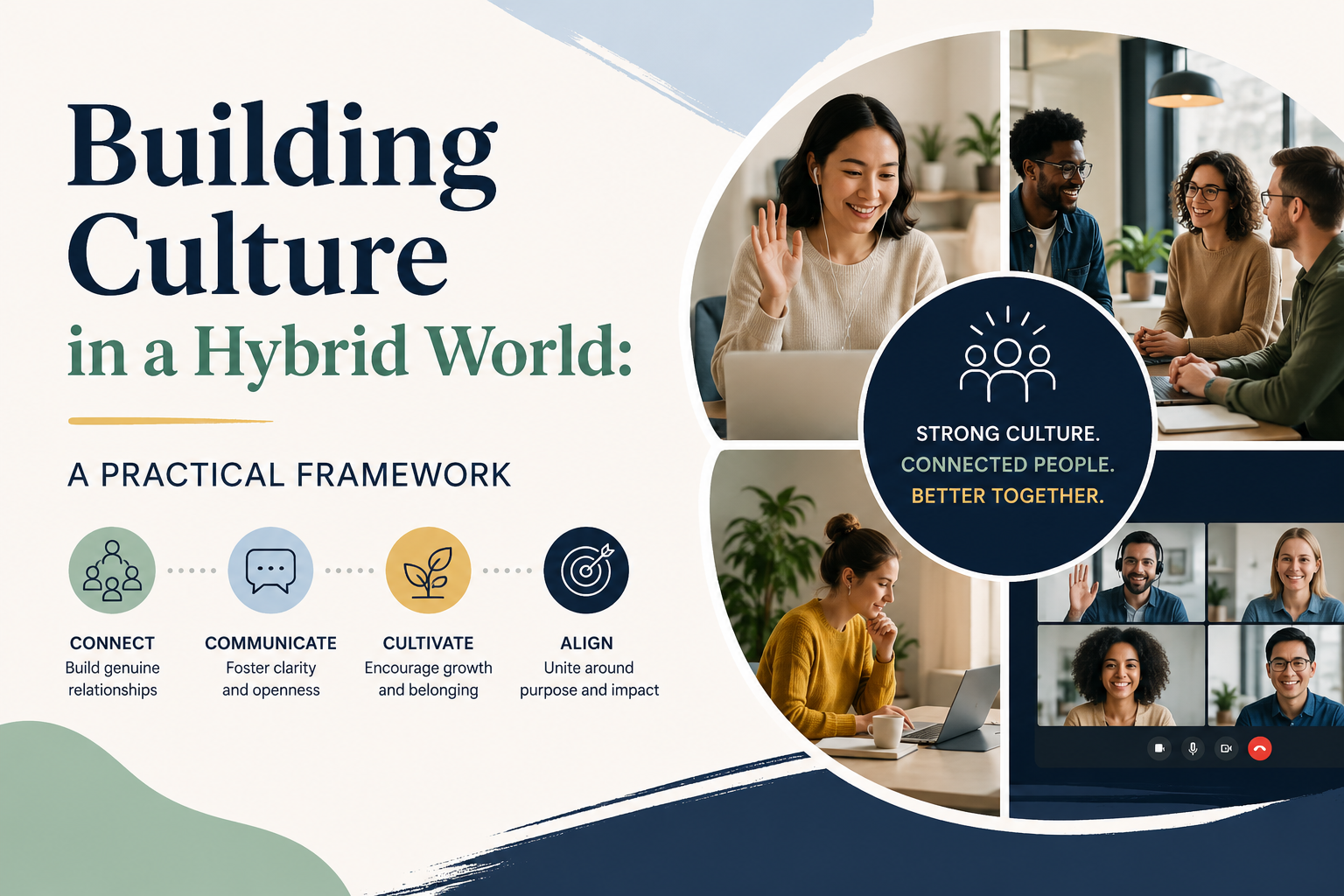
Culture isn't posters on walls. It's what happens when nobody's watching. In a hybrid world, the deliberate architecture of culture has never been more important.
Culture is what happens when the CEO isn't watching. It is the sum of a thousand small behaviors, rituals, decisions, and norms that accumulate over time into something that either enables or limits an organization's potential.
In a co-located world, culture is transmitted through proximity — through watching how a senior leader handles a difficult conversation, through the informal hallway exchange that shows what really gets rewarded around here, through the energy of a shared space. In a hybrid world, you've lost the automatic transmission mechanism. Culture doesn't disappear. But it stops replicating itself without intention.
What Hybrid Actually Breaks
The cultural risks of hybrid work are specific and worth naming clearly, because the solutions depend on understanding the actual problem.
Informal learning disappears. Junior employees who would have absorbed organizational culture by proximity — by watching, listening, and observing the informal as much as the formal — now have far fewer of those learning moments. They can complete their job responsibilities from home, but they aren't absorbing how things actually work.
Visible inequity emerges. Hybrid arrangements rarely affect everyone equally. Those who can come in — typically those with proximity to power — get more visibility, more relationship access, and implicitly, more career opportunity. Unless this is actively managed, hybrid accelerates inequality.
“Every culture question is a leadership question in disguise.
— Sanjay Koul
The Three-Pillar Framework for Hybrid Culture
Over several years of advisory work with organizations navigating hybrid, I've distilled the approach into three pillars. Each must be actively designed — none emerge automatically.
Pillar 1: Deliberate Rituals
Identify the cultural moments that matter most — team starts, retrospectives, wins celebrations, difficult conversations — and design them with intention for a hybrid context. Don't let them die because the mechanism changed.
Pillar 2: Values as Behaviors
Your values statement means nothing. Your values behaviors mean everything. Define, for each value, what it looks like in a specific observable interaction. Then create accountability for those behaviors, not the words on the wall.
Pillar 3: Intentional Connection
Schedule what used to be spontaneous. The informal connection that happened naturally in-office must now be engineered. This includes virtual coffees, non-agenda conversations, and deliberate cross-functional exposure for junior employees.
The Leader's Role: Modeling, Not Mandating
Culture change is never achieved through policy. It is achieved through modeling. The single most powerful culture lever a leader has is their own visible behavior. When the CEO responds to a failure with curiosity rather than blame, that one moment communicates more about psychological safety than any Slack post or culture initiative.
In a hybrid world, this means leaders must be more deliberate about where and when they model cultural behaviors. The moments are fewer and therefore each one carries more weight. Be intentional about what you're demonstrating in every team interaction — because your team is watching, even when you think they're not.
Culture in a hybrid world isn't automatic. It is architecture. And like all architecture, it requires a designer who understands both the structure and the people who will live in it.