After coaching 500+ leaders across industries, I've observed that greatness in leadership rarely comes from grand strategy — it comes from five foundational decisions made consistently, under pressure, over time.
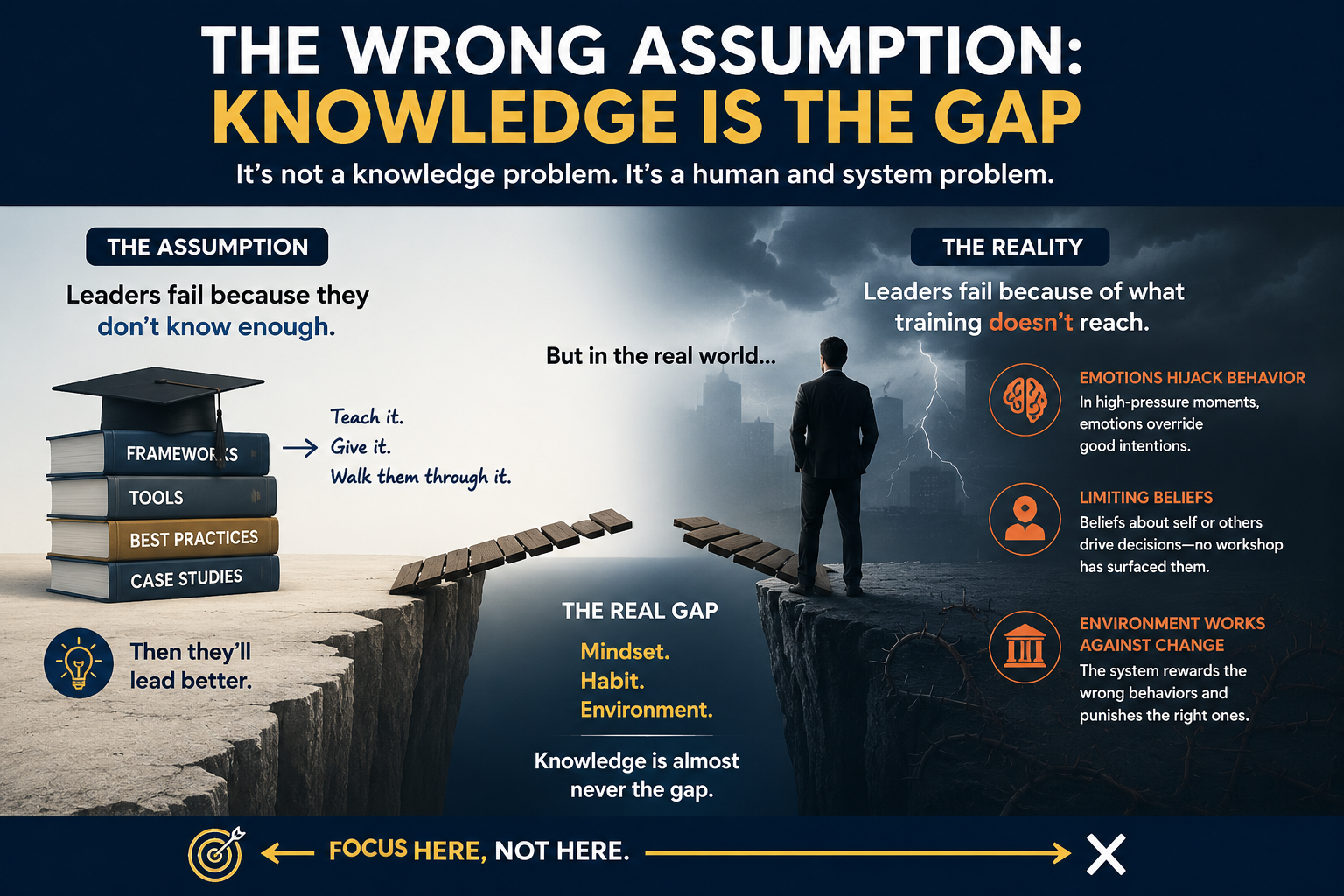
Most leadership development focuses on skills — communication, strategy, delegation, influence. These matter. But after three decades of corporate leadership and coaching 500+ leaders, I've come to a different conclusion about what actually separates great leaders from merely good ones.
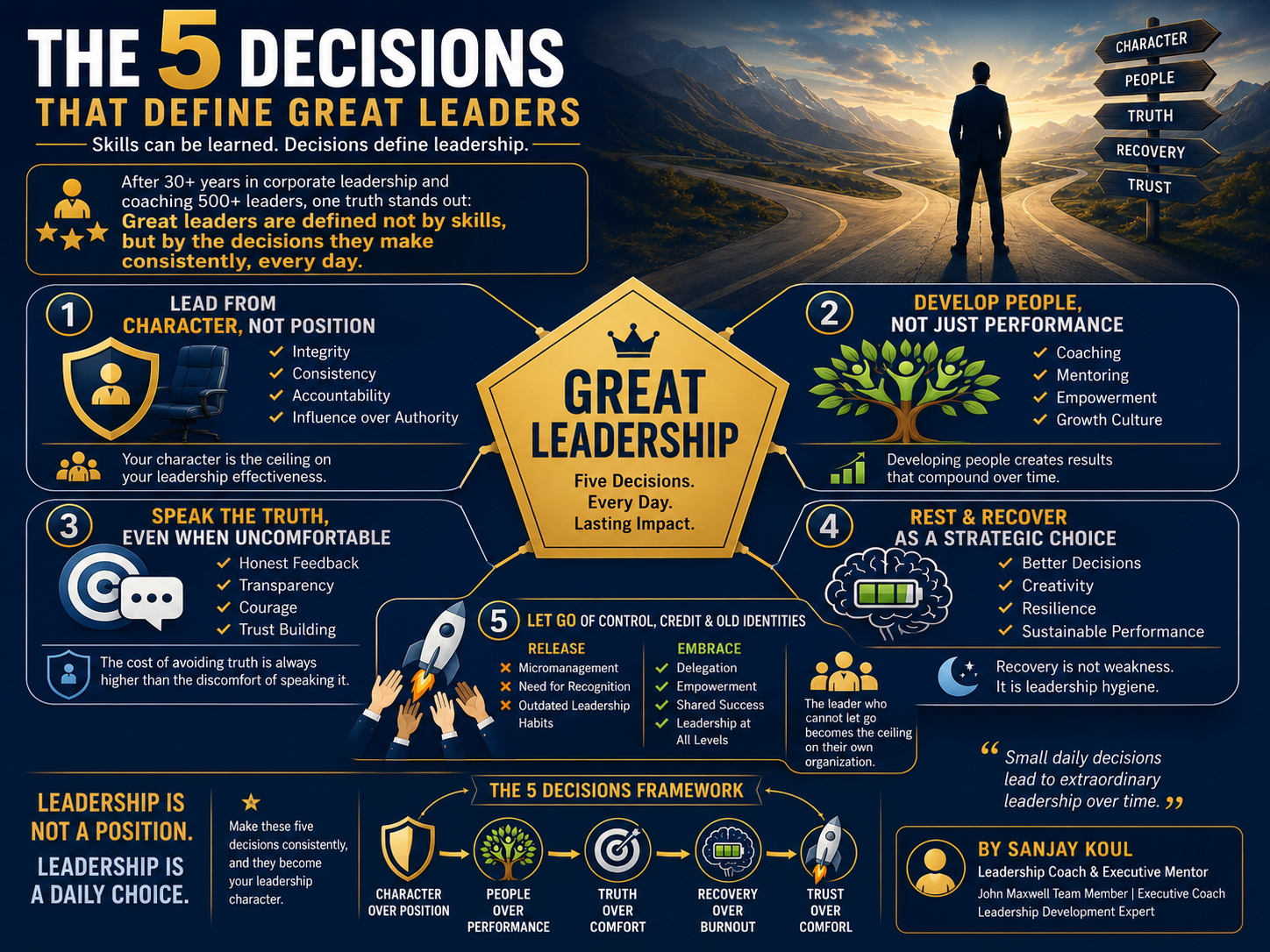
Great leaders are not defined by their capabilities. They are defined by their decisions — specifically, five foundational decisions they make consistently, under pressure, over time. Skills can be learned. These decisions must be chosen.
Decision 1: To Lead from Character, Not Position
The first and most foundational decision is to let your character drive your behavior — not your title. Many leaders operate from position power: 'I'm the CEO, therefore I will be respected.' They confuse authority with leadership.
Character-driven leaders earn their influence every day. They behave the same whether they are being watched or not. They hold themselves to higher standards than they hold others. John Maxwell calls this the 'Law of the Lid' — your character is the ceiling on your leadership effectiveness. No skill development will lift you beyond it.
“Your title gives you authority over people. Your character gives you influence with people. Only one of those actually matters.
— Sanjay Koul
Decision 2: To Develop People, Not Just Performance
The second decision is how you view the people around you. Many leaders see their team as a means to an outcome — resources to be deployed in service of results. They manage performance. They optimize output. They build machines.
Great leaders make a different choice: they decide that developing people is the work, not a distraction from it. When you invest in the growth of your team, you create a compounding effect that no strategy can replicate. The results take longer to appear. They last much longer when they do.
Ask more than you tell
Replace answers with questions that develop thinking.
Give credit liberally
Your success is always a product of the people around you.
Create safe failure
Teams that can fail safely learn faster.
Invest in their futures
Develop people for their next role, not just their current one.
Decision 3: To Speak the Truth, Especially When Uncomfortable
This is the decision most leaders avoid. Candor is uncomfortable. It creates friction. It risks relationships. But the absence of candor is far more costly — it allows problems to compound, lets mediocrity settle in, and erodes trust in ways that are very hard to rebuild.
Great leaders decide to be truthful even when it's difficult. They give honest feedback to poor performers. They challenge flawed plans from senior leaders. They tell customers what they need to hear, not what they want to hear. This requires courage. But it is the only way to build a culture where truth flows freely — and where the organization can actually solve its real problems.
Decision 4: To Rest and Recover as a Strategic Choice
Leadership culture glorifies exhaustion. Leaders who work 80-hour weeks wear it as a badge of honor. What they don't see is the cost: degraded judgment, diminishing creativity, increasing reactivity, and a team that models the same unsustainable pace.
The decision to rest — to protect sleep, take breaks, create space for thinking — is not weakness. It is leadership hygiene. The best decisions come from rested minds. My work in Hypnotherapy and Access Consciousness has shown me just how deeply chronic stress distorts thinking and perception. Sustainable high performance requires recovery as a non-negotiable practice.
“You cannot pour from an empty vessel. Rest is not the reward for work well done — it is the condition for work done well.
— Sanjay Koul
Decision 5: To Let Go — of Control, Credit, and Past Identity
The fifth decision is perhaps the hardest: the decision to release. To let go of needing to control every outcome. To release credit to others. To shed an identity that made you successful but no longer serves the organization you're trying to build.
Many founders struggle with this. They built something from nothing, and they cannot imagine it surviving without their fingerprints on everything. But organizations that scale are organizations where leadership is distributed. The founder who cannot let go eventually becomes the ceiling on their own creation.
These five decisions are not one-time events. They are daily choices — made in meetings, in conversations, under pressure, when no one is watching. Make them consistently, and they become your leadership character. Make them inconsistently, and they remain aspirations.