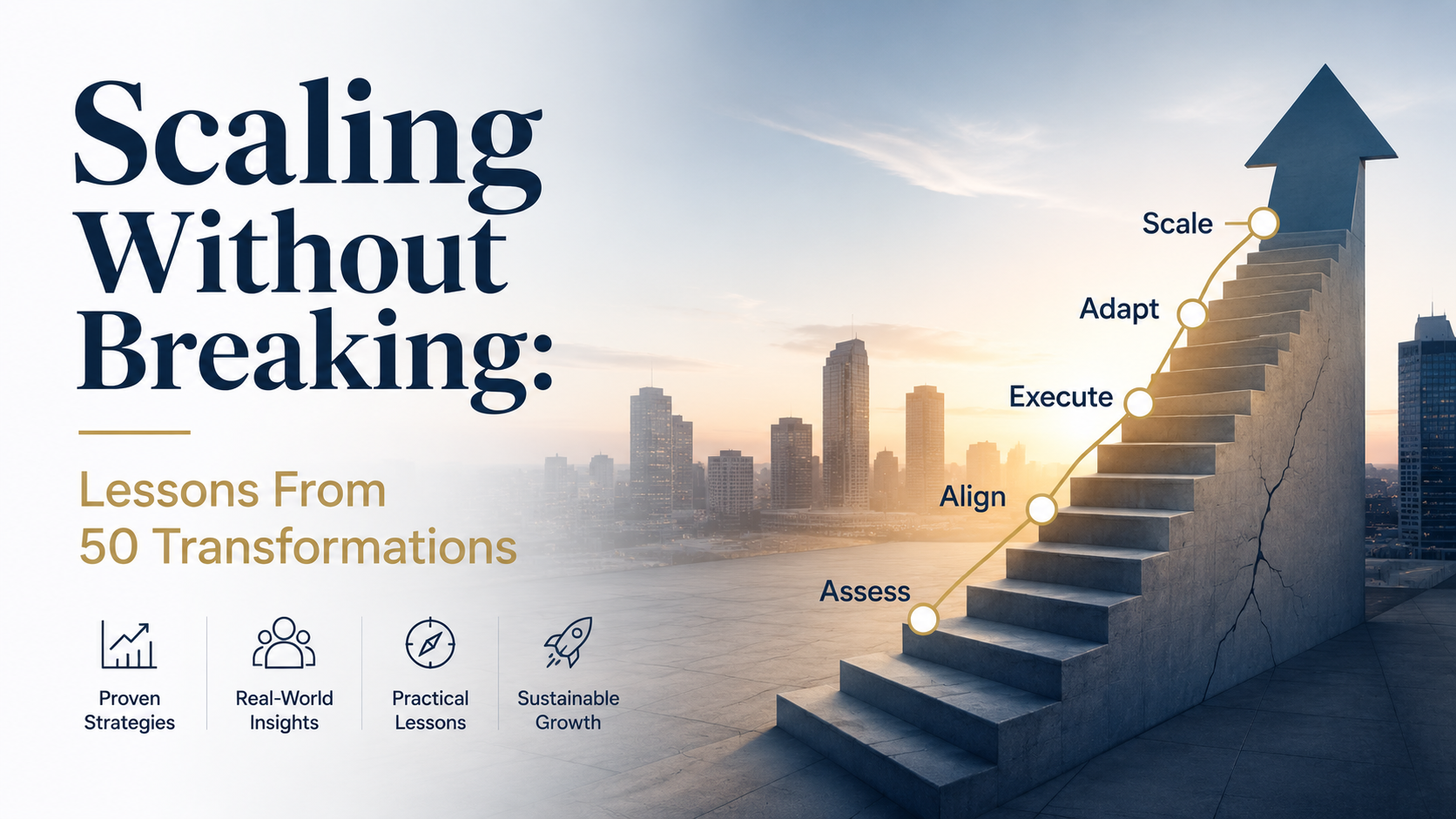
Most organizations that fail to scale don't fail because of bad strategy. They fail because their leadership infrastructure can't carry the load.
I have worked closely with more than 50 organizations through significant scaling phases — from 20 to 100 employees, from regional to national, from founder-led to professionally managed. The breakpoints are not random. They are almost always the same. And almost always, they are predictable long before they become crises.
The most expensive lesson in organizational scaling is this: the systems, structures, and leadership behaviors that made your organization successful at its current size will actively resist the organization you are trying to become.
The Three Common Fracture Points
Scale stress appears in three places with remarkable consistency. Understanding these fracture points before you hit them is the difference between a difficult quarter and an organizational crisis.
Communication Breakdown
At 30 people, the CEO can communicate directly with everyone. At 150, this is impossible — but many leaders keep trying. Critical information gets filtered, distorted, or lost. Decisions made at the top take weeks to reach the front line. The organization begins operating from different realities.
Culture Dilution
Culture is transmitted through proximity and modeling. When an organization grows fast — especially through hiring — the cultural transmission mechanism breaks down. New employees absorb the official culture (values posters, onboarding decks) but miss the lived culture. Over time, pockets of different sub-cultures emerge.
Leadership Infrastructure Gap
This is the most common and most costly fracture point. Organizations hire for technical skills and promote on performance. They build a management layer that has no actual management capability. The result: smart, high-performing individuals who don't know how to lead teams, develop people, or drive accountability.
The Scaling Paradox
Here is the paradox that surprises most scaling leaders: the faster you grow, the more you need to slow down and invest in your leadership infrastructure. Every week you defer that investment, you are building organizational debt — patterns, gaps, and behaviors that will cost multiples more to address later.
The organizations that scale successfully are those that treat leadership development as a scaling prerequisite, not a scaling reward. They build management capability before they need it. They create communication architecture before the informal mechanisms break. They codify culture before dilution becomes invisible.
“You cannot fix leadership infrastructure under load. You must build it before the load arrives.
— Sanjay Koul
A Framework for Scaling Leadership
The framework I use with organizations preparing to scale focuses on four dimensions — each of which must be deliberately designed, not left to emerge.
People
Map the leadership capability you will need at 2x your current size. Identify the gaps. Begin developing from within and hiring deliberately for those gaps now.
Process
Define your decision-making architecture. Who decides what? What requires escalation? What is genuinely delegated? Without this, every important decision flows upward and creates bottlenecks.
Culture
Articulate your values as behaviors. Design the rituals and practices that will transmit them as you grow. Invest in culture carriers — the people who embody what you stand for.
Metrics
Define how you will measure leadership effectiveness — not just business performance. If you only measure business outcomes, you will optimize for business outcomes at the cost of leadership development.
The Hard Truth About Scaling
Scaling is a leadership problem wearing a business costume. Every operational challenge that surfaces during a high-growth phase — the miscommunication, the attrition, the execution gap, the culture friction — has a leadership root cause.
The organizations that scale without breaking are those that recognize this early enough to act on it. They invest in their people with the same rigor they invest in their product or market. They understand that their leadership infrastructure is their competitive moat.
Scale the leadership infrastructure first. The business will follow.